In Gauguin's Footsteps at Le Pouldu
We tend to picture Paul Gauguin beneath the palm trees of Tahiti. Yet before the South Seas, it was in Brittany — and more precisely here, at Le Pouldu, in the commune of Clohars-Carnoët — that the painter found one of his most fertile studios. To stay in the village today is to walk in the footsteps of a small artistic revolution.
Why did Gauguin come to Le Pouldu?
By the late 1880s, Pont-Aven was already too crowded with painters for Gauguin's liking. He was looking for somewhere wilder and quieter, where the light and the landscapes stayed raw. Le Pouldu — then a simple fishing hamlet huddled at the mouth of the river Laïta — offered exactly that: vast beaches, sunken lanes, low farmhouses and an ever-changing sea.
In 1889 and 1890, Gauguin returned several times, often in the company of his friends Paul Sérusier, Charles Filiger and the Dutch painter Meyer de Haan. The little band settled into Marie Henry's inn, nicknamed "la Buvette de la Plage" (the Beach Tavern).
Marie Henry's house, a life-size studio
Marie Henry's inn became far more than lodging. The painters decorated its walls, doors, windows and even ceilings — sometimes paying for their board in canvases. This "decorated room" remains famous in art history as one of the manifestos of the Pont-Aven school and of Synthetism, that new way of painting in flat areas of colour bounded by bold lines.
Today, the Maison-musée du Pouldu offers a faithful reconstruction of the tavern and immerses visitors in the atmosphere of those heady years. It's a short but memorable visit, perfect for a rainy spell as much as for a break between swims.
Our walking "Gauguin" itinerary
From the guest house, you're just minutes from the places that inspired these paintings. Here's a simple half-day loop:
- Start at the Grands Sables beach, a vast stretch where the morning light is superb.
- Head to the Maison-musée du Pouldu to grasp the context and recognise some of the landscapes.
- Continue along the GR34 coastal path, which follows the coast towards the Laïta estuary — the raw setting Gauguin was after.
- Finish facing the sea, where land and salt meet — the very idea behind the house's name, "between land and sea."
A still little-known angle
Many English-speaking visitors and art lovers don't realise this chapter of Gauguin's life played out here, in Clohars-Carnoët, rather than in Pont-Aven. That's what makes the discovery so enjoyable: you enjoy first-rate heritage without the crowds.
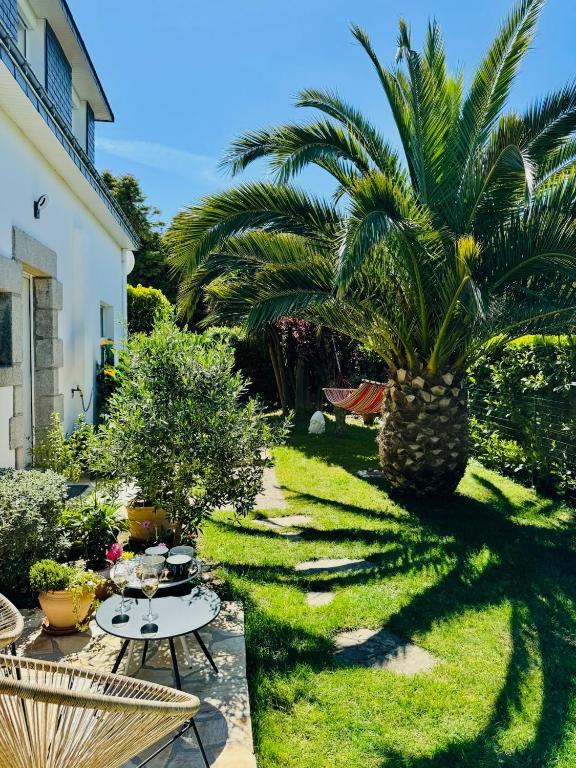
Staying a stone's throw from these places, in a Breton longère surrounded by a palm garden, is the luxury of taking your time: painting, reading, walking, and watching the light shift over the sea — exactly as the artists did more than a century ago.
"I love Brittany: I find here the wild, the primitive." — Paul Gauguin
Fancy living this interlude yourself? The studio is waiting, just minutes from Le Pouldu and its beaches.
Our Brittany notebooks
The Best Beaches Around Clohars-Carnoët
Grands Sables, Bellangenêt, Le Kérou, Saint-Maurice… Our guide to the beaches of Le Pouldu and beyond, to pick yours according to mood and tide.
Read articleHiking the GR34, the Customs Officers' Path
The famous coastal path winds along the shore of Clohars-Carnoët. Our guide to the finest stretches of the GR34 from Le Pouldu and Doëlan.
Read articleDoëlan, the Most Photogenic Fishing Port in Finistère
Two lighthouses, colourful boats and artists at every turn: ten minutes from the house, the little harbour of Doëlan is well worth the detour.
Read article